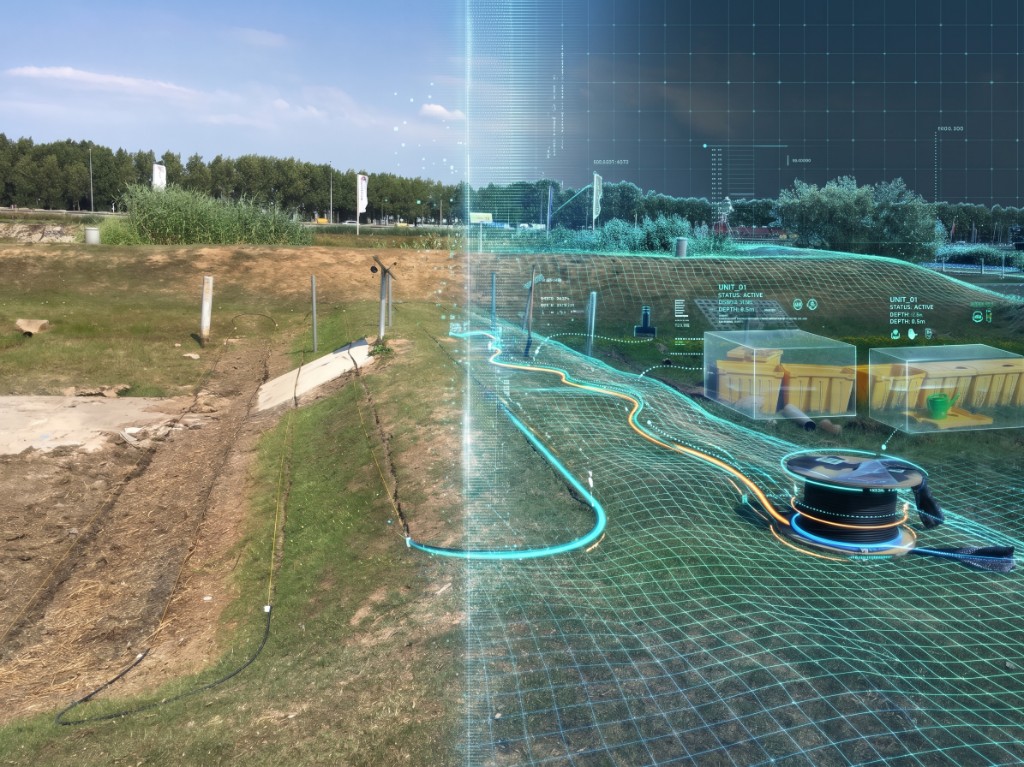
We instrument flood defences, model them and couple surrogates of them with the sensors to increase the flood resilience of flood-prone areas. This is how we envisioned the Structural Flood Resilience.
Structural flood resilience refers to increasing a flood-prone system's inherent resilience (the capacity to resist, absorb, adapt and recover) through thorough understanding and monitoring of permanent flood defences, such as dikes, dams, detention ponds and demountable structures that are partially installed, temporary structures that are removable, as well as dry and wet floodproofing of structures, to meet construction standards to deflect, absorb or resist pressure without breaking during high-water flood events.
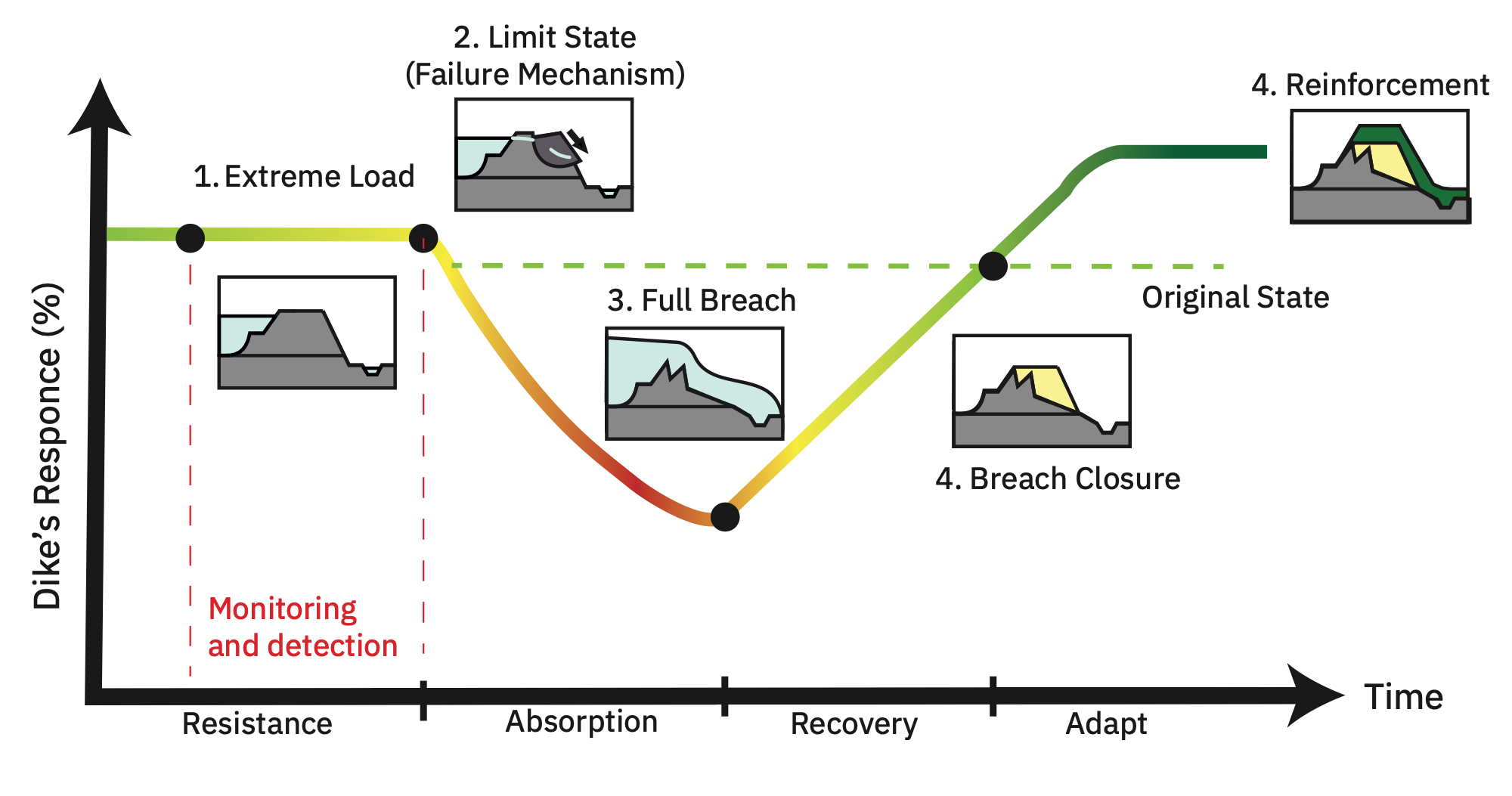
A dike's response through resistance, absorption, recovery and adaptation. Monitoring and detection come before the limit state. Concept and design by Juan Aguilar-López.
A system is resilient when it keeps an acceptable level of function during and after a disruption, and regains full function within a set time. The curve has two parts. Before the event, monitoring and changes in the defence improve how it performs. After the event, repair brings the function back. Resilience-based design asks for more than survival of a design load: it asks how quickly the defence, and the area that depends on it, can work again. Not every structure can be made resilient to every hazard. The aim is to provide the functions that defence needs.
The curve follows the functionality diagram in Khaloo and Mobini, Scientia Iranica (2016), adapted from McDaniels (2008) and Bruneau et al. (2003), and is drawn here for a dike.
What we work on
Models, surrogates, and the sensing that feeds them.
Flood defences fail slowly enough that a good measurement, read in time, can still change the outcome.
01
Multi-physics modelling
The physical understanding is often reflected in models that have to be solved as partial differential equations. Multi-physical approaches allow the processes and their feedback loops to be described more clearly, so that the time dependence is better described.
02
Surrogate modelling
Surrogate models are aimed at imitating the original numerical models while avoiding the actual numerical solution of the partial differential equations. This makes them fantastic tools for real-time prediction, forecasting and reliability.
03
Fiber-optic sensing
Strain, temperature and acoustics along dikes and movable barriers allow spatially continuous sensing, which reduces the uncertainty due to heterogeneity. It also allows anomalies to be detected at a finer spatial resolution.